
Medication Recall: What to Do and How a Patient Advocate Can Help


.svg)
- Medication recalls are scoped to specific lot numbers and National Drug Codes, not to a whole drug, so the lot number printed on your bottle tells you more than the drug name in the headline.
- What you should do next depends on the recall. Some recalls direct patients to stop and return the product right away. Others direct patients to keep taking their medication until a replacement is in hand.
- Your pharmacy usually hears about a medication recall before your prescriber does, and nobody automatically informs you.
- A patient advocate confirms whether your fill is affected, calls the pharmacy, keeps your prescriber informed, and follows the replacement through so your treatment isn't interrupted.


Learn more about Solace and how a patient advocate can help you.
Hearing that a medication you take has been recalled can be frightening, especially when the news doesn’t tell you what it means for your prescription. Recalls tend to arrive as a news alert rather than a phone call. The notice goes to manufacturers, distributors, and pharmacies, not the patients that it directly impacts.
The first step is finding out whether the medication recall applies to your specific fill. Recalls are almost always limited to specific lot numbers, so a headline naming your drug doesn't necessarily mean your fill is affected. Once it’s confirmed, the next step is to reach out to your pharmacy. Guidance differs from one recall to the next and the pharmacy can check your specific fill against the affected lots.

Medication recalls are more common than you'd think
Two recalls can look identical in a headline yet need opposite actions. What separates them is the reason for the recall, which can be found in the official FDA notice.
The risk can be immediate
Some recalls involve contamination that could harm someone with one dose. These notices usually tell patients to stop taking the product immediately.
Example: Cetirizine hydrochloride, July 2026
What happened: Unique Pharmaceutical Laboratories recalled four lots of the generic Zyrtec tablets after a pharmacy technician noticed discolored tablets with red dots while counting out a bottle.
What it was dangerous: Testing traced it to cross-contamination with ranitidine, which can cause a severe allergic reaction in people sensitive to it. The FDA classified it Class I, its most serious category.
What patients were told: Stop taking it immediately. The distributor contacted affected customers to arrange returns.
The risk can be prolonged
Other recalls involve an impurity that matters over years of exposure. Those notices often tell patients to keep taking their medication until a replacement is ready, because stopping a medication you need carries an immediate risk of its own.
Example: Valsartan, losartan, and irbesartan, 2018–2023
What happened: The recalls began in July 2018, after nitrosamine impurities were found in valsartan. They widened over the following years to cover lots of losartan and irbesartan from a number of manufacturers as testing continued.
Why it was dangerous: Nitrosamines are probable human carcinogens, and the concern was repeated exposure over years rather than harm from any single dose.
What patients were told: Keep taking it. The FDA advised patients to continue their current medication until a pharmacist supplied a replacement or a doctor prescribed something else.
The takeaway: those two recalls called for close to opposite responses, and in both cases the instructions were published alongside the recall. An advocate reads the lot number and the recall notice and tells you which of these two situations you're in.
How a patient advocate can help with medication recalls
The work of a recall gets split across a pharmacy, a prescriber, sometimes an insurer, and none of them are talking to each other. A Solace advocate communicates across touch points and keeps care aligned.
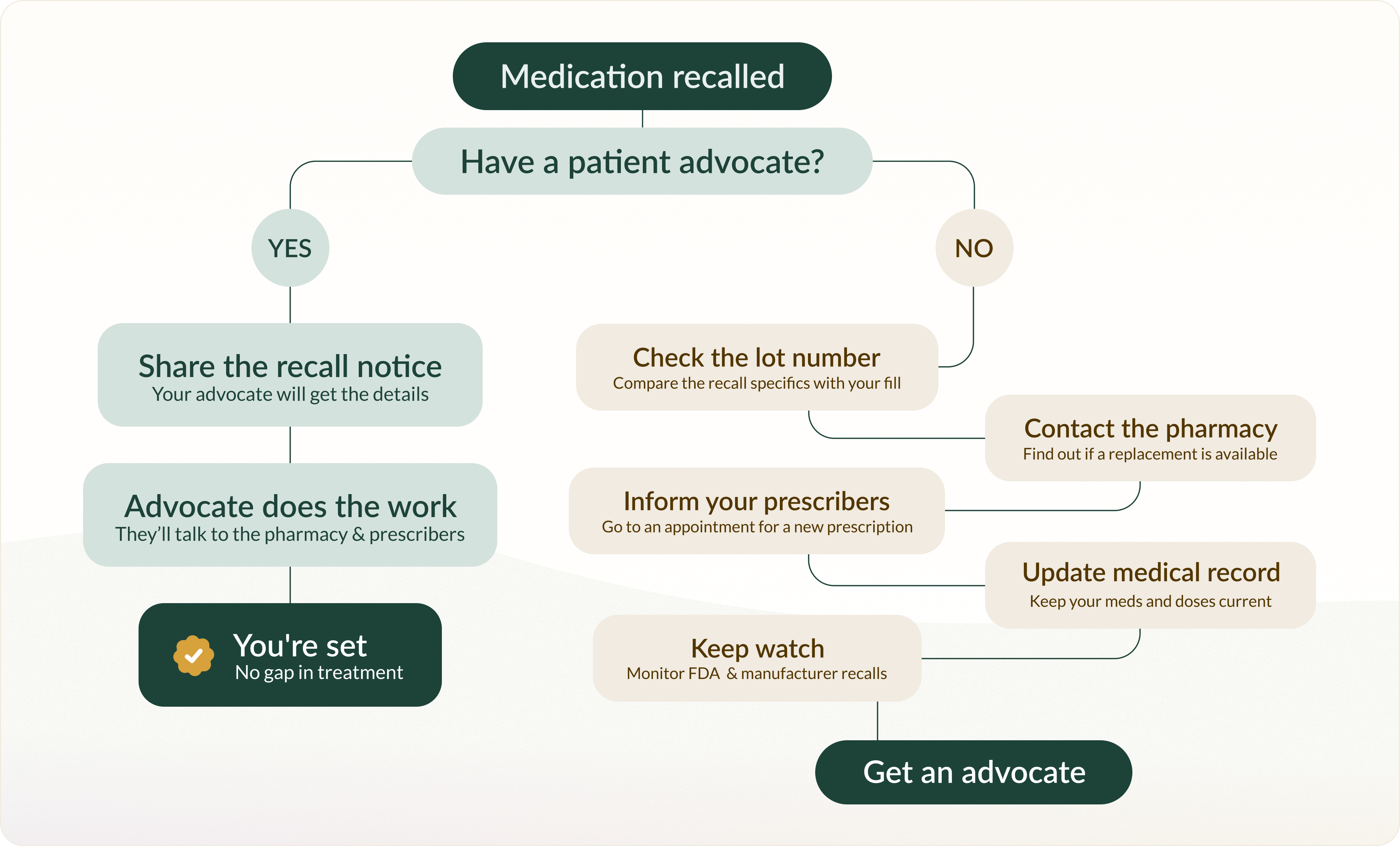
Step 1: Confirming whether your fill is affected
The lot number is printed on your prescription label or on the bottle itself, usually near the expiration date. That number, along with the National Drug Code, is what the FDA's recall notice lists.
A Solace advocate starts by finding that number in your pharmacy's fill record, then checks it against the current FDA notice.
Step 2: Calling the pharmacy with the right questions
Pharmacies are often notified by their distributors before recall coverage appears, so a pharmacist can frequently check your fill faster than you can look it up. A Solace advocate calls the dispensing pharmacy and asks:
- Does the exact fill you received match one of the affected lots?
- What is the process for returning or exchanging the recalled product?
- Is a replacement from an unaffected lot in stock now?
That third question determines whether there's a gap in treatment. If the answer is no, the advocate coordinates with the prescribing provider while the return gets sorted out.
Step 3: Looping in your prescriber
An advocate contacts the prescriber, confirms they're aware of the recall, and asks if they’d like to wait for restocked lots or write for something different. The prescriber makes that call. Your advocate makes sure the decision reaches the pharmacy, your medication list, and any other provider managing a related condition.
Step 4: Covering the gap while a replacement is arranged
If your prescriber switches you to a different medication, that prescription may sit on a different insurance tier and require prior authorization. Here, an advocate:
- Submits the prior authorization request right away and follows it through the review
- Files the appeal if it comes back denied
- Arranges delivery for homebound patients
A recall can also thin the supply of the unaffected batches and the alternative medications. An advocate finds out whether you're looking at a short delay or a real shortage, then coordinates with your prescriber and pharmacy from there.
Step 5: Updating your record
Once the recall is resolved, your advocate will update your medication list, your pharmacy record, and your provider notes reflect your current prescriptions. That coordination makes the next recall, the next drug interaction check, or the next emergency room visit faster and safer.
This is just one component of the advocate relationship, the same relationship that helps patients stay on top of appointments and to-do lists, communicate with doctors, and avoid the record mismatches that cause bigger problems down the line. It's the same steady process behind other recall situations Solace has covered, like the recent cetirizine recall.
FAQs
What should I do if I get a medication recall notice?
Confirm the specific lot number is actually affected, then contact your pharmacy to check your fill and arrange a replacement. If the pharmacy doesn’t have a safe fill, let your prescriber know so they can make a medical decision about next steps.
If my medication is recalled, should I stop taking it right away?
Generally no, but you should confirm with your pharmacist or prescriber before continuing. The FDA's standard guidance is to keep taking your current medication until your pharmacist provides a replacement or your doctor prescribes an alternative, since stopping a needed medication abruptly can carry its own risks. However, some recalls can be life-threatening.
How do I know if my specific medication was actually recalled, not just the drug in general?
Recalls are almost always scoped to specific lot numbers and National Drug Codes, not an entire drug. Check the lot number printed on your bottle against the FDA's posted recall list, or ask your pharmacist to check your specific fill directly, since pharmacies are often notified before news coverage appears.
What happens if my medication is recalled and there's also a shortage?
Recalls sometimes trigger a temporary shortage of the unaffected product, which happened repeatedly during the 2018–2023 blood pressure medication recalls. In that case, your prescriber may switch you to a therapeutic alternative rather than wait for restocked supply.
Why would I need help with a medication recall instead of just calling my pharmacy myself?
You can absolutely call your own pharmacy. An advocate is most useful when you're managing multiple medications, multiple prescribers, or don't have the bandwidth to chase down the lot number, the pharmacy, and your prescriber as soon as the recall hits the news.
- U.S. Food and Drug Administration. "Recalls of Angiotensin II Receptor Blockers (ARBs) including Valsartan, Losartan and Irbesartan." https://www.fda.gov/drugs/drug-safety-and-availability/recalls-angiotensin-ii-receptor-blockers-arbs-including-valsartan-losartan-and-irbesartan. Accessed August 2026.
- U.S. Food and Drug Administration. "FDA Updates and Press Announcements on Angiotensin II Receptor Blocker (ARB) Recalls (Valsartan, Losartan, and Irbesartan)." https://www.fda.gov/drugs/drug-alerts-and-statements/fda-updates-and-press-announcements-angiotensin-ii-receptor-blocker-arb-recalls-valsartan-losartan. Accessed August 2026.
- CBS News, “Antihistamine recall across the U.S. triggered by heartburn drug contamination risk, FDA says”
https://www.cbsnews.com/news/allergy-medication-recall-2026-zyrtec/ - KFF. "Medicare Advantage Insurers Made Nearly 53 Million Prior Authorization Determinations in 2024." https://www.kff.org/medicare/nearly-50-million-prior-authorization-requests-were-sent-to-medicare-advantage-insurers-in-2023/. Accessed August 2026.
- National Library of Medicine, “Current Status of Angiotensin Receptor Blocker Recalls”
https://pmc.ncbi.nlm.nih.gov/articles/PMC7021211/ - Pharmacy Times, “Valsartan Recall: FDA Issues Warning to API Manufacturer”
https://www.pharmacytimes.com/view/valsartan-recall-fda-issues-warning-to-api-manufacturer